
Decolonising the Clock
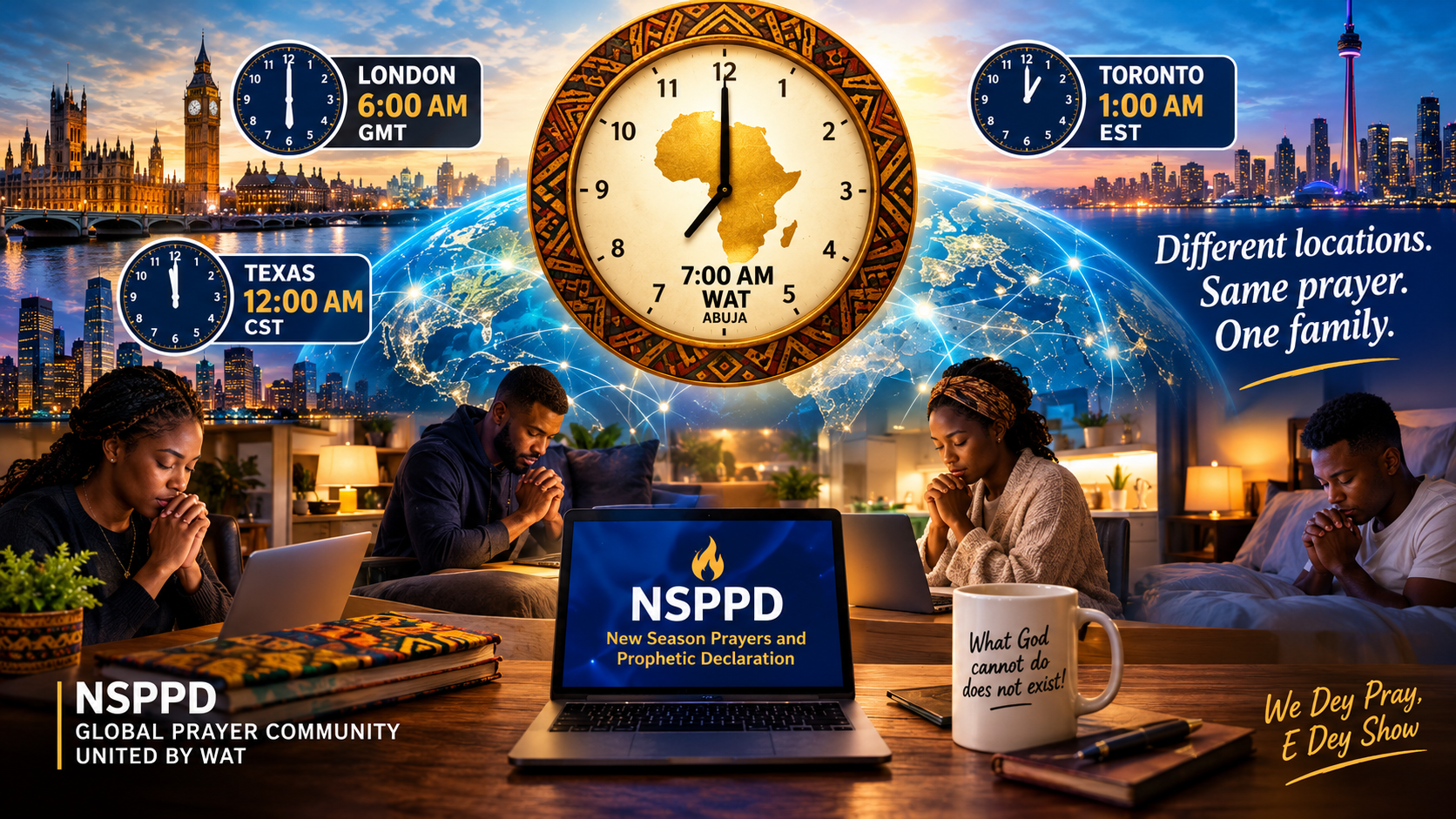
Today's post is by CRPL Visiting Research Fellow Dr. Nduka Udeagha. The topic of this timely post centres on NSPPD, West Africa Time, and the subversion of Western temporal hegemony. With the clocks having just changed, have you considered some of the imperial overtones of this bi-annual event? If not, read on...

"What God cannot do does not exist!" For the millions across the world who recognise this declaration, these words are the unmistakable signature of NSPPD, New Season Prophetic Prayers and Declarations. These words express the faith and collective identity of the participants of this global prayer movement, which is led by Nigerian pastor Jerry Eze.
Every weekday at 7 a.m. West Africa Time (WAT), worshippers from across the world gather online for a synchronised act of prayer centred on Abuja. Bedrooms, living rooms, kitchens, and student hostels in cities such as London, Houston, and Toronto become extensions of the NSPPD altar. Through digital technology, the Nigerian religious movement has cultivated a global community of prayer that transcends national borders and time zones.
The movement's scale alone warrants scholarly attention. According to data published by Streams Charts, NSPPD accumulated more than 102 million livestream watch hours in 2025, making it the highest-ranked African creator in global livestream watch hours and the third most-viewed non-gaming livestream channel on YouTube. Such figures reveal the massive scale of this transnational religious community organised around an African spiritual authority. Through daily acts of temporal alignment, NSPPD advances a subtle yet significant decolonial project: the centring of African time within a global religious network.
As autumn arrives across the Global North and clocks have shifted once again, NSPPD draws attention to a dimension of colonial legacy that is often overlooked: the politics of time. Clock changes and Daylight Saving Time (DST) transitions are routine features of life in Europe and North America, usually discussed in terms of seasonal affective shifts, economic productivity, or circadian rhythms. But for hundreds of thousands of Christians participating in NSPPD, these temporal shifts demand a different form of recalibration.
To understand the radical nature of NSPPD’s temporal regime, one must first examine how time was mobilised as a technology of colonial subjugation. Historically, temporal standardisation was not a neutral, technical convenience. It was a mechanism of imperial control, inclusive of racialized labour discipline, and of what Gayatri Chakravorty Spivak (1988) calls epistemic violence. E. P. Thompson's influential essay, “Time, Work-Discipline, and Industrial Capitalism” (1967), demonstrates how the rise of industrial capitalism transformed older task-orientated rhythms into the discipline of "clock-time," a system designed to regulate labour, maximise efficiency, and structure everyday conduct. During the nineteenth century, this temporal order travelled alongside empire.
Giordano Nanni's The Colonisation of Time (2012) develops a related argument by examining how colonial power reshaped temporal practices and understandings. He argues that colonial rule was not imposed only through armies, laws, and economic extraction. It was also imposed through the clock. Colonial administrators and Christian missionaries frequently regarded indigenous temporalities, organised around seasons, agricultural cycles, communal obligations, and indigenous ritual life, as signs of disorder or backwardness. Consequently, in settler-colonial Victoria and the Cape Colony, colonial authorities constructed "Aboriginal time" and "African time" as temporal deficiencies requiring correction. The introduction of European clocks, church bells, missionary schools, timetables, and labour discipline became tools through which Indigenous and African peoples were coerced into the rhythms of empire and Christian norms.
At a global level, these processes of temporal standardisation reached a decisive moment in the late nineteenth century. In Britain, Greenwich Mean Time became legal time in 1880. Four years later, the International Meridian Conference adopted the Greenwich meridian as the international reference point for longitude. While this decision reflected practical concerns relating to navigation and global coordination, it also reflected the geopolitical influence of the British Empire, whose maritime dominance had already established Greenwich as a global temporal reference point.
Anthropologist Johannes Fabian (1983) described a related dimension of colonial power as the "denial of coevalness." Colonial ideologies frequently positioned Western societies as embodiments of modernity while representing colonised peoples as existing in an earlier stage of historical or evolutionary development. Time itself became hierarchical. Europe occupied the present and future; the colonised world was cast into an imagined past, deemed primitive. The West set the clock, and the rest of the world was expected to follow.
It is against this backdrop that NSPPD assumes a significance that extends beyond digital religion. NSPPD directly subverts this hierarchy. By maintaining an immutable anchor at 7:00 a.m. West Africa Time, the movement symbolically relocates the centre of global devotional time from the traditional metropoles of the Global North to Abuja. Instead of accommodating the temporal preferences of Europe or North America, participants across the world voluntarily adjust their lives to a rhythm determined in Abuja. In this sense, NSPPD performs what Walter Mignolo (2009) describes as “epistemic disobedience” and “decolonial freedom.” It represents a refusal of the assumption that meaningful global rhythms must originate from traditional centres of Western power.
What makes NSPPD's temporal sovereignty so striking is its absolute consistency. Whether the leadership is broadcasting from Abuja or travelling to Atlanta, London, or elsewhere in Western time zones for international prayer conferences, the global broadcast for the daily morning rituals stays locked to 7:00 AM West Africa Time. During a recent NSPPD America tour, the daily prayer was broadcast live from the US at 1:00 AM Central Daylight Time (CDT). Rather than shifting the broadcast time to fit local Western schedules, the ministry requires its host to adapt to African time. NSPPD turns the traditional hierarchy of time on its head.
This commitment becomes particularly visible during seasonal clock changes. A typical ministry announcement reads:
NSPPDIANS IN THE UK & EUROPE, PLEASE TAKE NOTE! As daylight saving time ends… your local time for NSPPD will be: 🇬🇧 UK & 🇮🇪 Republic of Ireland: 6AM GMT 🇪🇺 Central European Time: 7AM CET We continue to gather at 7AM WAT! Reset your alarms, spread the word, and keep your appointment on the altar of fire! 🇺🇸🇨🇦 US & Canada, your clock change follows ... Stay tuned! WHAT GOD CANNOT DO DOES NOT EXIST!
Importantly, the movement does not translate or accomodate itself into Western modes of worship to become globally acceptable. The language used on NSPPD remains distinctly African in character. Popular declarations such as "We dey pray, e dey show" ("we pray and it manifests"), alongside English-language worship, songs in Nigerian languages, indigenous expressions, prophetic declarations, and culturally familiar forms of spiritual communication, remain central to the prayer experience. Likewise, the intensity, expectations, prayer styles, and temporal discipline of the movement are unapologetically shaped by African Pentecostal spirituality.
NSPPD's temporal authority depends on its digital infrastructure. Livestreaming, online communication and social media connect participants who live thousands of miles apart. This digital gathering also transforms the meaning of the family altar. In many African Christian contexts, the family altar refers to a regular practice of collective prayer within the household. NSPPD extends this idea across geographical boundaries. Through livestreams flooded with real-time declarations and interactive chats, private spaces across foreign nations are re-consecrated into a sacred African prayer sanctuary.
NSPPD's reach also extends beyond African diaspora communities. Its online format enables people from different national and cultural backgrounds to participate in the same prayer gathering. The movement's African roots remain significant, but its reach is not confined to Africans living abroad. Its schedule now creates a common point of reference for a wider international religious community.
This is an embodied decolonial practice. Waking at midnight in Texas, 1:00 AM in Toronto, or 6:00 AM on a dark London winter morning to pray on West African time is a chosen sacrifice. Diaspora believers, alongside non-African participants drawn into the movement, deliberately prioritise an African devotional clock over local schedules. Their ultimate allegiance is with a spiritual centre in the Global South.
As clocks continue to shift across the Global North, NSPPD reminds us that time is never merely a temporal matter. It is also cultural, spiritual, and political. By inviting a global community to organise itself around an African devotional rhythm, NSPPD offers a compelling example of temporal decolonisation in the digital age. Beyond academic theories and debates, NSPPD demonstrates that decolonisation can be lived through everyday disciplines. Every weekday, participants across continents reorder their routines around a clock anchored in Abuja. In doing so, they participate in a reversal of colonial temporal hierarchies.
For centuries, under imperial rule and Western hegemony, Africa adjusted its rhythms to clocks set elsewhere. NSPPD asserts a radical alternative, where West Africa defines global time. For scholars across the humanities and religious studies, the central question shifts from whether African Pentecostalism can participate in global Christianity to how it actively resets the temporal metronome through which global faith is lived. Judging by the millions across continents who reorder their sleep around West Africa Time, that transformation has become a daily, lived reality. In the declarative language of the altar itself: what God cannot do does not exist.
References
Fabian, J. (1983). Time and the other: How anthropology makes its object. Columbia University Press.
Mignolo, W. D. (2009). Epistemic disobedience, independent thought and decolonial freedom. Theory, Culture & Society, 26(7–8), 159–181.
Nanni, G. (2012). The colonisation of time: Ritual, routine and resistance in the British Empire. Manchester University Press.
Spivak, G. C. (1988). Can the subaltern speak? In C. Nelson & L. Grossberg (Eds.), Marxism and the interpretation of culture (pp. 271–313). University of Illinois Press.
Thompson, E. P. (1967). Time, work-discipline, and industrial capitalism. Past & Present, 38, 56–97.