
Religious Literacy and Social Justice: A CRPL Event
What is ‘religious literacy’? Why does religious literacy matter in a supposedly increasingly secular country? And how does facilitating religious literacy in educational contexts speak to issues of social justice?
These were some of the questions grappled with at the latest CRPL workshop, which hosted researchers on the Religious Literacy in Further Education: A Social Justice Approach project, funded by the St. Peter's Saltley Trust. The project aims to develop resources to support Further Education staff to teach social justice-based religion and belief literacy for the preparation of learners for employment and life in a diverse society. Led by Dr Paul-François Tremlett from the Open University, the project team also consists of Dr Ian Jones (St. Peter's Saltley Trust), Dr Rhiannon Grant (University of Birmingham), and Dr Aled Thomas (University of Leeds).
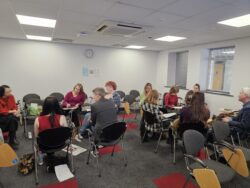
Group discussions in full swing
The workshop had two key purposes. The first was to introduce the project and its outputs to those in attendance (made up of CRPL researchers and TRS students). The second was to facilitate a discussion around the questions raised above. Through the course of the day, it became clear that what ‘religious literacy’ (and indeed non-religious literacy) entails is more than simply expertise in one or more religious tradition, but requires the kinds of citizenship skills captured by the the American Academy of Religion’s Guidelines for Teaching about Religion in K–12 Public Schools in the United States (Moore, 2010) which define religious literacy as ‘the ability to discern and analyse the intersections of religion with social, political, and cultural life’ (p. 4).
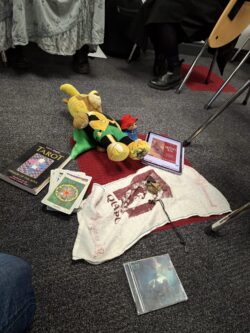
Objects representing 'religion' for the Cabinet of Curiosity
Following a discussion around these themes, attendees were asked to assemble a Cabinet of Curiosity, collating objects/images which they had been asked in advance to bring with them and which represented ‘religion’ (broadly conceived) to them. The objects they brought included tarot cards, a copy of The Hunger Games, a Build-a-Bear Loki, leaves, a sheep shrine, recorded music and some Filipino amulets. These may seem unconventional in comparison to what we may typically associate with ‘religion’, such as places of worship or sacred texts, but highlight the complex connections between individual lives and religion.
With these diverse perspectives in mind, Dr Ian Jones introduced the Religious Literacy in Further Education project, diving into a detailed discussion of the workshops that the project team had held in Further Education colleges in the West Midlands. This was followed by a series of role-play scenarios, through which participants brought their own experiences to situations in which religious literacy might be useful.
So far, the project team have two outputs from the project: a mini-documentary on ‘What is Religious Literacy?’, and a Religious Literacy animation, both of which were produced by the Open University. These outputs highlight some of the debates surrounding the concept and practice of religious literacy and some of the challenges and dynamics of putting it to work in the classroom. A series of podcasts are also in the pipeline, and will be shared via the CRPL Newsletter in due course.
For more information about this project contact:
Dr Paul-François Tremlett ([email protected])