
Researcher of the Month, March 2026: Flávio Lopes Arantes
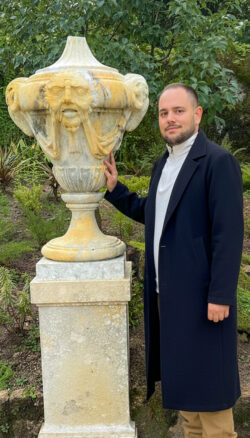
Photo courtesy of Flávio Lopes Arantes
Flávio Lopes Arantes is a PhD researcher in Religious Studies at Pontifícia Universidade Católica de São Paulo (PUC-SP, Brazil) and currently a Visiting Researcher at the University of Leeds. His doctoral research examines the historical formation of Modern Pagan Witchcraft and its establishment in Brazil, analysing how disputes over legitimacy, authority, and identity are structured within the Brazilian religious field in light of the movement’s English origins and its later development in the United States.
Tell us a little about your research journey. How did you get to where you are right now?
My research journey in Religious Studies began during my Master’s degree, when I became interested in Modern Paganism and Wicca as contemporary religious movements. For my MA research, I examined the foundational characteristics of British Wicca as a new religious movement. Drawing on historical and analytical methodologies, I sought to systematise the material produced by early figures associated with the movement and to construct an ideal type of Wicca in its seminal form.
This early work raised broader questions for me: how do religious movements travel across cultural boundaries, and how are they reshaped in the process? In my doctoral research, I expand this scope, moving from early British Wicca to the wider landscape of Modern Pagan Witchcraft. I am interested in understanding how the movement was historically established in the United Kingdom, how it was reshaped in the United States, and how it later became rooted in Brazil.
Through engagement with Brazilian Pagan communities, my research explores patterns of proximity and distance between Wiccan groups and the Brazilian Religious Matrix, asking whether it is possible to speak of a distinctly Brazilian configuration of Modern Pagan Witchcraft shaped by its cultural context.
My current visiting period at the University of Leeds offers a unique opportunity to deepen the historical dimension of my work, especially regarding the English origins of Wicca, and to engage directly with scholars working on contemporary religion in public life.
What are you currently working on?
At present, I am refining the first chapter of my thesis, which analyses the emergence of Modern Pagan Witchcraft in England in the 1940s–1960s as a plural and contested religious field rather than a unified tradition. This involves revisiting early disputes around legitimacy, lineage, and authority among figures such as Gerald Gardner, Alex Sanders, and Robert Cochrane, and examining how these tensions shaped the initial configuration of the movement.
I am also structuring the next stage of the project, which considers how Modern Pagan Witchcraft was reconfigured in the United States before being translated into Brazil. A subsequent empirical phase of the research will involve interviews with Brazilian Pagan groups, examining how they position themselves within the field, particularly in relation to the adoption or rejection of the labels “Wicca” and “Witchcraft”.
Being based in the UK during this stage of the project allows me to engage more directly with the historical and cultural environment in which the movement first took shape. This context provides an important horizon for understanding how regional identities of the religion emerge and are subsequently reinterpreted in different cultural settings.
How does your work relate to some aspect of religion and public life?
Although Modern Pagan Witchcraft is often perceived as marginal, it raises important questions about religion in public life: how minority religions negotiate visibility, how historical narratives are mobilised to construct identity, and how global religious movements are adapted within local cultural frameworks.
In Brazil, where Modern Pagan Witchcraft has been present for roughly three decades, the movement remains in a formative phase. Its groups operate within a complex religious landscape shaped by Catholicism and Protestantism, as well as by Spiritism, Afro-Brazilian traditions, and Indigenous religious and spiritualities. Within this plural environment, questions of identity boundaries (what counts as “Wicca”, what counts as “Witchcraft”, and how these relate to broader religious categories) become especially significant.
My research therefore examines how Brazilian Pagan groups negotiate their place within this wider religious environment, how they consolidate internal identities, and how they seek public recognition and legitimacy. More broadly, the project contributes to discussions about how emerging religious fields define their boundaries and articulate coherent public self-understandings within pluralistic societies.