
Diasporic Faiths and Sacred Identities: Reflections from Kraków
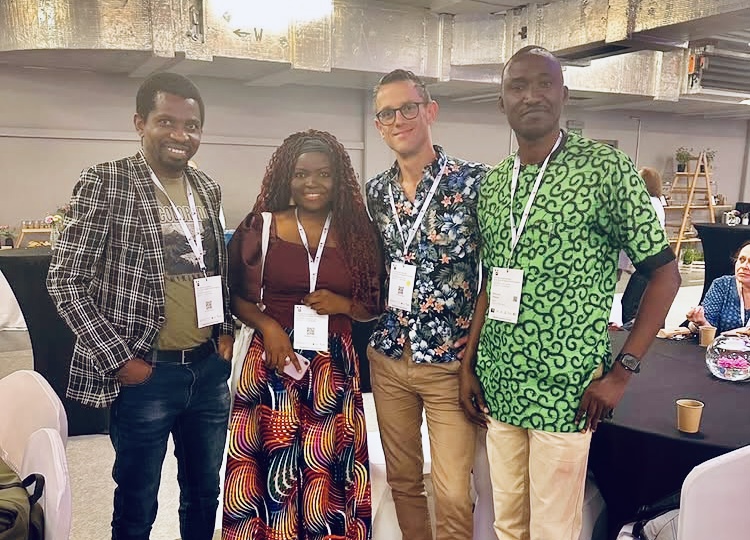
Today's post is a reflection by Dr. Nduka Udeagha. Nduka is a long-time supporter and former visiting research fellow of CRPL. He recently attended and presented at the IAHR (International Association for the History of Religions) Congress, held in Kraków, Poland.
In August 2025, I attended the XXIII World Congress of the International Association for the History of Religions (IAHR) in Kraków, Poland. The Congress was hosted by Jagiellonian University and marked an extraordinary triple anniversary: 125 years since the first World Congress of Religious Studies, 75 years of the IAHR, and 25 years of the European Association for the Study of Religions (EASR). The thematic focus of the Congress was “Out of Europe: Studying Religion(s) in Interconnected Worlds.” It was within this framework that I shared my work, which critically engages with religion and migration.
On arrival in Kraków, near John Paul II International Airport, a statue of Jesus, standing on the left side of the road, greeted me. This unexpected welcome and prominent presence of Christian sanctity (by comparison with Leeds, where I have been living these past years) struck me. This was compounded two days later, on a quiet evening walk down Mazowiecka Street where I lodged: a dim light caught my eye from a verdant corner. Drawing closer, I found it emanated from a small shrine with a statue of the Virgin Mary. These encounters with public religious symbols, embedded in everyday spaces, resonated deeply with the core of my research about how migrants carry, adapt, and express their spiritual identities in new environments.
My research explores how Nigerian immigrants in West Yorkshire, who are part of the so-called Japa Syndrome (a popular term from Nigeria that captures the large wave of emigration driven by economic challenges, insecurities, and systemic hardships), navigate their spiritual lives. Through qualitative research, including interviews and ethnographic fieldwork, I examine how migration both consolidates and reshapes spiritual practice, communal affiliation, and theological orientation. My study adopts a decolonial lens by centring three Nigerian proverbs from distinct ethnolinguistic traditions to analyse diasporic religious adaptation through African indigenous knowledge. The three proverbs are: the Igbo Ebe onye bi ka ọ na-awachi (“Where one lives is where one fortifies”), the Yoruba Ibi tí a ti ń gbé ni a ti ń rí (“Where one lives is where one is perceived”), and the Hausa Idan gari ya canza, hali ya canza (“When the town changes, character changes”).
Sharing this work at the Congress, I was reminded that the theme “Out of Europe” was not simply geographical but epistemic: a call to imagine religion through frameworks that do not begin only in Europe. My use of Nigerian proverbs as analytical tools exemplified this, offering a language of migration and belonging rooted in African wisdom traditions. Audience engagement made clear how my approach can open fresh possibilities for decolonial studies and comparative dialogue, while also unsettling assumptions that often universalise European categories.
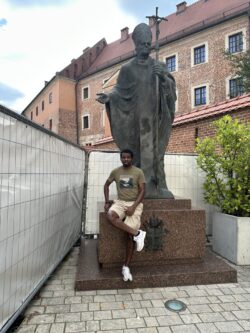
This theme of navigating worldviews moved from the theoretical to lived actuality as I explored the city of Kraków. At the National Museum I encountered art that weaves together different religious traditions with secular narratives, prompting me to consider how religious identities are visually and publicly negotiated. Walking through the Old City with three other colleagues, at the heart of the Kraków square, we encountered majestic ancient churches: St Mary’s Basilica, one of the most iconic, where I had a moment of prayer, and the Church of St Adalbert. Afterwards, we moved further downward to Wawel Hill, where the majestic Wawel Cathedral stands. This is the Royal Arch-Cathedral Basilica of Saints Stanislaus and Wenceslaus, perched atop the hill. It’s where Karol Wojtyła (later, Pope John Paul II) served, and outside the cathedral stands a statue of him, where we took some pictures.
Coming down from Wawel Hill and turning left, we reached the Vistula, Poland’s longest river. It curves gracefully past the castle and cathedral, offering boat rides and stunning views of Kraków’s skyline. My special moment during the boat ride was being allowed to steer the boat, a generous gesture by the captain. On that water, I felt the fluidity of movement and perspective, reflecting, for me, the immigrants I interviewed, who are also navigating new currents, the secular flow of British society, and their own faith, learning to steer a course that honours their past while adapting to their present.
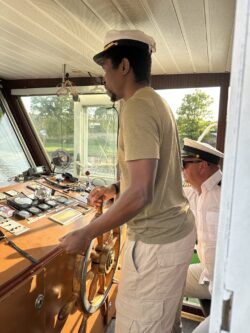
"Captain" Udeagha! Images are courtesy of Nduka Udeagha.
The congress in Kraków was more than an academic event; it was a journey through sacred spaces and shared ideas. My perception of migration and faith found new depths in this setting. The Kraków experience revealed to me something about how in migration, public religion is in a constant state of motion, unfolding in different ways across borders.
I am grateful to Prof. Johanna Stiebert for enabling my attendance and to Prof. Adriaan van Klinken for his guidance.
The two images of Nduka Udeagha are courtesy of the author. The featured image is from a post in the CRPL Instagram account and depicts (from left to right) Nduka Udeagha, Gloria Adichie, Adriaan van Klinken, and Ibukunolo Olodude, at the IAHR Congress.